Common Hospital Management Problems and How to Solve Them
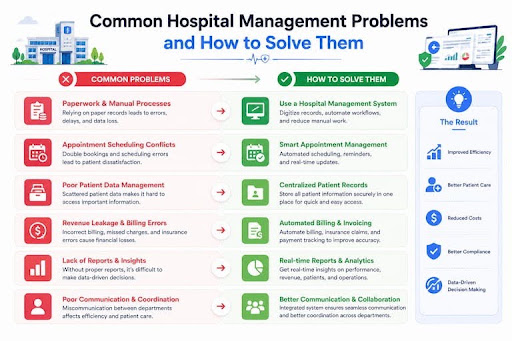
Managing a hospital involves much more than taking care of patients. Hospitals have to coordinate reception, doctors, staff, pharmacy, laboratory, accounts, patient records, and several other departments every day.
When these departments rely on manual processes or different tools, managing daily operations can become complicated. Information can get duplicated, reports may take longer to prepare, and staff can spend unnecessary time on repetitive tasks.
In this guide, we’ll look at some of the most common hospital management problems and how hospitals can solve them with better processes and a centralized Hospital Management System.
Common Hospital Management Problems
Using Different Platforms or Tools for Each Department
One common problem hospitals face is using different platforms, spreadsheets, or tools for different departments.
For example, the reception team may use one system for patient registration, the accounts department may maintain financial records in spreadsheets, and the pharmacy may use another tool to manage inventory.
Although these tools may work individually, managing information across multiple platforms can become difficult.
- How to solve it: A centralized Hospital Management System can bring different departments together on one platform. Instead of switching between multiple tools, staff can manage their department's activities through connected modules. This can make information easier to access and reduce unnecessary manual work.
Poor Patient Record and Reception Management
Patient registration and record management are some of the most important daily activities in a hospital.
When patient information is managed manually, hospitals may face problems such as duplicate records, missing information, slow registration, and difficulty finding previous patient data.
Reception staff may also have to spend more time searching for information instead of focusing on patients.
- How to solve it: A digital patient management system can help hospitals store patient information in an organized way. Reception staff can register patients, access existing records, and manage patient information more efficiently. This can make the registration process faster while keeping important patient information organized.
Difficulty Managing Hospital Income and Expenses
Hospitals handle many financial activities, including patient payments, salaries, operational expenses, pharmacy sales, and other costs.
When income and expenses are recorded manually, it can become difficult to maintain accurate financial records and prepare reports.
Management may also have difficulty understanding where money is being spent or how much income the hospital is generating.
- How to solve it: Hospitals can use an accounts management system to record income and expenses in an organized manner. Financial reports can help management understand the hospital's financial performance and make better decisions based on accurate information.
Challenges in Managing Doctors and Staff
Hospitals need to manage many doctors and employees with different responsibilities and schedules.
Keeping track of doctor schedules, staff attendance, salaries, and employee information manually can become time-consuming, particularly as the hospital grows.
Communication problems can also occur when information is spread across different records.
- How to solve it: A hospital management system can provide dedicated doctor and staff management features. Hospitals can use these features to organize schedules, track attendance, manage salary information, and maintain employee records from one place.
Difficulty Managing Multiple Departments
A hospital can have several departments working at the same time, including reception, doctors, pharmacy, laboratory, accounts, and HR.
The larger the hospital becomes, the more difficult it can be to coordinate these departments.
If each department works independently, important information may not be easily available to other authorized staff members.
- How to solve it: A centralized hospital management system can connect different departments through a single platform. Each department can have access to the features and information it needs while management can have a broader view of hospital operations.
Disorganized and Repetitive Work
Another common problem is repetitive manual work.
Staff may need to enter the same information into multiple systems, prepare reports manually, search through records, or repeatedly perform tasks that could be automated.
Over time, this can waste staff time and increase the possibility of human errors.
- How to solve it: Hospitals can reduce repetitive work by using software that centralizes information and automates common processes. When information is properly connected between modules, staff can spend less time on administrative tasks and more time focusing on their primary responsibilities.
How a Hospital Management System Solves These Problems
A Hospital Management System can help bring different areas of hospital operations together.
Instead of managing patient records, accounts, pharmacy, staff, doctors, and other departments separately, hospitals can use connected modules within one system.
Some of the main benefits include:
- Centralized hospital information:
- Better patient record management:
- Easier financial tracking:
- Improved staff and doctor management:
- Better pharmacy and inventory management:
- More organized department operations:
- Reduced repetitive manual work:
- Faster access to important information:
- Easier reporting and decision-making:
However, simply purchasing software does not automatically solve every management problem. Hospitals should choose a system that matches their actual requirements and is easy for staff to use.
How to Choose the Right Hospital Management System
Before choosing a Hospital Management System, hospitals should identify the areas where they currently face the most difficulties.
Consider whether the system provides the modules your hospital actually needs, such as patient management, reception, doctors, staff, accounts, pharmacy, laboratory, and inventory.
It is also important to consider ease of use, reporting capabilities, data security, scalability, customer support, and overall cost.
The right system should not make hospital operations more complicated. It should help simplify them.
How HMS PLUS Helps Solve Common Hospital Management Problems
HMS PLUS is designed to help hospitals manage different areas of their daily operations through a centralized system.
It provides modules for areas such as reception, doctors, accounts, pharmacy, HR, laboratory, and administration.
By bringing these functions together, HMS PLUS can help hospitals reduce dependency on multiple tools and manage their operations in a more organized way.
For small and growing hospitals, having these management functions available through one system can make it easier to keep information organized as the hospital expands.
Frequently Asked Questions
What Are the Most Common Hospital Management Problems?
Common hospital management problems include inefficient patient record management, difficulty managing multiple departments, manual financial tracking, staff and doctor management challenges, disconnected software, and repetitive administrative work.
How Can a Hospital Management System Reduce Manual Work?
A Hospital Management System can centralize information, automate common processes, reduce duplicate data entry, and make important records and reports easier to access.
How Can Hospitals Manage Multiple Departments Efficiently?
Hospitals can manage multiple departments more efficiently by using a centralized system that connects departments such as reception, doctors, pharmacy, laboratory, accounts, and HR.
Can a Hospital Management System Manage Patient Records and Accounts?
Yes. Depending on the software, a Hospital Management System can include modules for patient records, reception, accounts, billing, financial reports, and other hospital operations.
How Does Hospital Management Software Save Time and Money?
Hospital management software can reduce repetitive administrative work, improve record organization, simplify reporting, and help staff manage daily operations more efficiently. This can save staff time and reduce the costs associated with inefficient manual processes.
Get Started With HMS PLUS
Managing a hospital becomes more difficult when important information is scattered across different tools and departments.
A centralized Hospital Management System can help bring these operations together, reduce repetitive work, and give hospital management better control over daily activities.
If your hospital is facing these challenges, HMS PLus can help you manage your hospital operations through one centralized platform.