HMS Blog
Notes on hospital operations, digital records, and the small decisions that add up to a facility that runs on time.

What Is a Hospital Management System? A Complete Guide
Running a modern hospital or clinic means managing hundreds of moving parts every single day. From the moment a patient walks through the front door to their final prescription pickup and payment settlement, dozens of departmental handoffs occur. When these handoffs rely on paper files, physical registers, or disconnected software tools, operational friction builds up fast, leading to long waiting lines, billing errors, and exhausted medical staff.

Why Does Hospitals Need a Hospital Management System
Managing a modern hospital or clinic is one of the most complex operational challenges in healthcare. Every single day, hundreds of patient interactions, clinical decisions, diagnostic test requests, inventory movements, and financial transactions take place simultaneously across multiple departments. When these daily workflows are managed through paper logs, manual registers, or isolated desktop applications, operational efficiency breaks down quickly.

How Hospitals Can Manage Income and Expenses Efficiently?
Managing hospital finances is fundamentally different from running a traditional business. Between managing unpredictable patient admissions, handling third-party insurance claims, maintaining complex medical inventory, and tracking doctor consultation commissions, healthcare revenue management requires constant oversight. When financial operations rely on paper ledgers, fragmented spreadsheets, or non-specialized accounting tools, hospitals experience hidden financial drains and delayed billing cycles.

How to Manage Multiple Hospital Departments Efficiently?
Managing a multi-department healthcare facility is an intricate operational juggling act. On any given shift, your registration desk, outpatient clinics, inpatient wards, laboratory, radiology unit, pharmacy, accounting office, and HR department are all operating simultaneously. When these units function as isolated islands, communication breaks down, handoffs stall, and operational friction mounts quickly.

How HMS PLUS Helps Small and Growing Hospitals Manage Their Operations
Small and growing hospitals face a unique operational dilemma: they handle many of the same complex responsibilities as large medical institutions—such as patient admissions, pharmacy inventory, lab testing, and billing—but often have to manage them with smaller teams and limited budgets. Relying on paper charts, manual registers, or basic office software leads to operational drag, long patient wait times, and hidden revenue leaks.
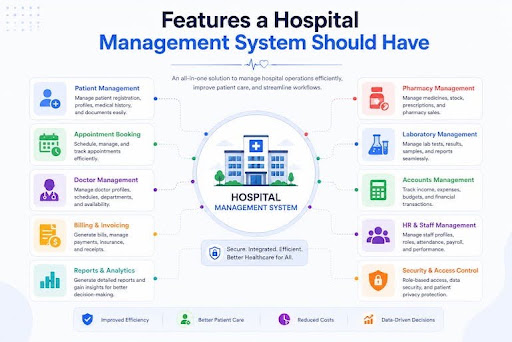
Top Features Every Hospital Management System Should Have
Modern healthcare facilities handle hundreds of patient visits, diagnostic requests, medication prescriptions, and financial transactions every day. Managing these complex workflows with paper records or disconnected software causes long waiting times, administrative errors, billing mistakes, and delayed patient care.
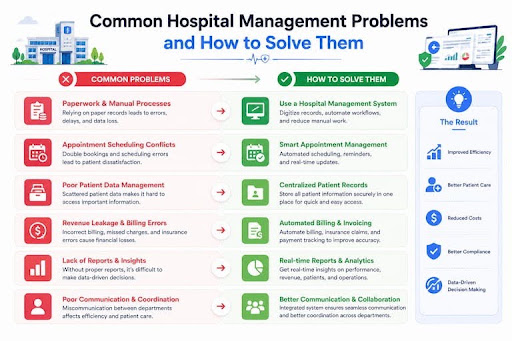
Common Hospital Management Problems and How to Solve Them
Managing a hospital involves much more than taking care of patients. Hospitals have to coordinate reception, doctors, staff, pharmacy, laboratory, accounts, patient records, and several other departments every day.
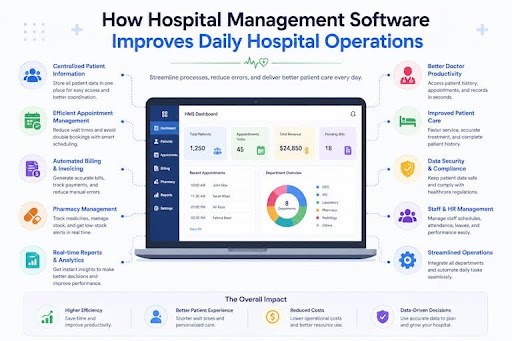
How a Hospital Management System Improves Daily Hospital Operations
Running a hospital or healthcare clinic involves managing hundreds of daily patient visits, clinical appointments, laboratory tests, pharmacy prescriptions, and financial transactions. Coordinating these operations manually or using disconnected software leads to long patient queues, misplaced records, administrative fatigue, and revenue loss.
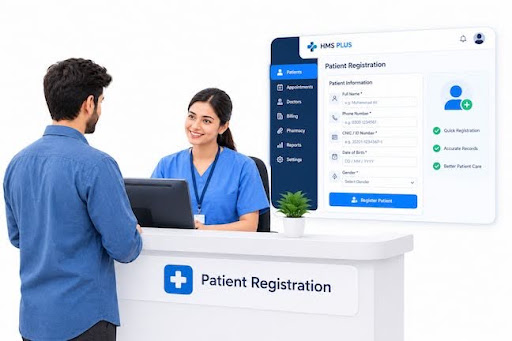
How to Improve Patient Registration in Hospitals
Learn how to improve patient registration in hospitals, why it matters, common registration problems, and practical ways to solve them.