Hospital Management System vs Electronic Health Record: What Is the Difference?
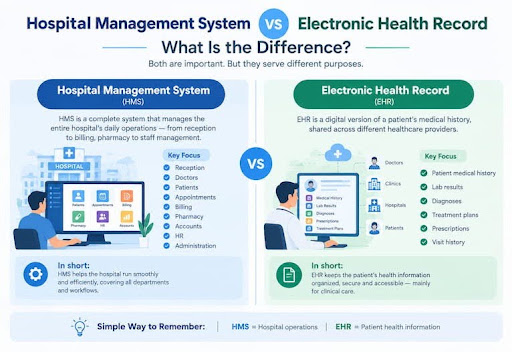
When evaluating digital solutions for a hospital, clinic, or medical practice, two terms come up more than any other: Hospital Management System (HMS) and Electronic Health Record (EHR).
While both technologies are essential pillars of modern healthcare IT, confusing them can lead healthcare leaders to invest in software that fails to cover their day-to-day operational needs.
An EHR focuses on patient clinical records and data portability across care providers. In contrast, an HMS serves as the overarching operational, financial, and administrative engine that runs an entire healthcare facility.
This guide breaks down the core differences between an HMS and an EHR, explains how they intersect, and helps you determine which solution fits your facility's goals.
HMS vs EHR: Quick Comparison
EHR (Clinical Network)
Patient Histories & Medical Portability Across Providers
HMS (Hospital Operating System)
Reception, OPD/IPD, LIS, Pharmacy, Billing, Accounts
| HMS vs EHR SCOPE MAP | |
|---|---|
| EHR (Clinical Network) | Patient Histories & Medical Portability Across Providers |
| HMS (Hospital Operating System) | Reception, OPD/IPD, LIS, Pharmacy, Billing, Accounts |
Primary Focus
Electronic Health Record (EHR): Comprehensive clinical health history and interoperable patient records
Hospital Management System (HMS): Complete operational, administrative, financial, and departmental management
Data Mobility
Electronic Health Record (EHR): Shared securely across external healthcare networks, labs, and specialists
Hospital Management System (HMS): Shared internally across all hospital departments (reception, billing, pharmacy, labs)
Primary Users
Electronic Health Record (EHR): Physicians, nurses, clinical specialists, care coordinators
Hospital Management System (HMS): Receptionists, doctors, lab technicians, pharmacists, accountants, HR staff, administrators
Administrative Scope
Electronic Health Record (EHR): Minimal (focused primarily on clinical charting and health summaries)
Hospital Management System (HMS): High (manages queue tokens, bed allocation, staff rosters, inventory, and billing)
Financial Capability
Electronic Health Record (EHR): Basic insurance code logging and billing support
Hospital Management System (HMS): Comprehensive central billing, itemized department invoice generation, and financial accounting
Best Suited For
Electronic Health Record (EHR): Multi-branch clinics and healthcare networks needing shared clinical data
Hospital Management System (HMS): Multi-department clinics, surgical centers, diagnostic centers, and full-scale hospitals
| Feature / Dimension | Electronic Health Record (EHR) | Hospital Management System (HMS) |
|---|---|---|
| Primary Focus | Comprehensive clinical health history and interoperable patient records | Complete operational, administrative, financial, and departmental management |
| Data Mobility | Shared securely across external healthcare networks, labs, and specialists | Shared internally across all hospital departments (reception, billing, pharmacy, labs) |
| Primary Users | Physicians, nurses, clinical specialists, care coordinators | Receptionists, doctors, lab technicians, pharmacists, accountants, HR staff, administrators |
| Administrative Scope | Minimal (focused primarily on clinical charting and health summaries) | High (manages queue tokens, bed allocation, staff rosters, inventory, and billing) |
| Financial Capability | Basic insurance code logging and billing support | Comprehensive central billing, itemized department invoice generation, and financial accounting |
| Best Suited For | Multi-branch clinics and healthcare networks needing shared clinical data | Multi-department clinics, surgical centers, diagnostic centers, and full-scale hospitals |
What Is an Electronic Health Record (EHR)?
An Electronic Health Record (EHR) is an interoperable digital repository of a patient’s overall health history. Unlike a local Electronic Medical Record (EMR) that remains locked within a single practice, an EHR is built to follow the patient across different healthcare providers, diagnostic laboratories, and medical networks.
EHR DATA PORTABILITY NETWORK
Primary Care Clinic
──┐
Diagnostic Testing Labs
──┼─► [ Secure EHR Platform ]
Specialty Surgical Center
──┘
| Primary Care Clinic | ──┐ |
| Diagnostic Testing Labs | ──┼─► [ Secure EHR Platform ] |
| Specialty Surgical Center | ──┘ |
Core Features of an EHR
- Longitudinal Health Histories: Tracks chronic conditions, past surgeries, clinical diagnoses, and treatment plans over time.
- Interoperable Data Protocols: Uses standardized data frameworks (such as HL7 and FHIR) to communicate securely with external systems.
- Clinical Decision Support: Triggers automated safety alerts for drug-to-drug interactions, known allergies, and missing immunization updates.
- E-Prescribing & Diagnostic Orders: Allows physicians to submit electronic prescriptions and order lab work directly from the consultation screen.
Primary Purpose of an EHR
The primary goal of an EHR is to ensure clinical continuity and patient safety. When a patient arrives at an emergency room or a new specialist's office, authorized clinicians can immediately access their verified medical history, preventing duplicate testing and dangerous drug interactions.
What Is a Hospital Management System (HMS)?
A Hospital Management System (HMS) is an enterprise healthcare management software platform designed to connect, automate, and manage the complete operational, administrative, and financial lifecycle of a medical facility.
CENTRALIZED HMS ARCHITECTURE
Front-Desk & Admissions
Reception, OPD/IPD Queues
Diagnostics & Medicine
Laboratory (LIS) & Pharmacy
Operations & Finance
Centralized Billing, HR, Stock
| Front-Desk & Admissions | Reception, OPD/IPD Queues |
| Diagnostics & Medicine | Laboratory (LIS) & Pharmacy |
| Operations & Finance | Centralized Billing, HR, Stock |
Core Features of an HMS
- Patient Registration & Reception: Manages front-desk check-ins, generates Unique Health Identification (UHID) numbers, coordinates Inpatient (IPD) bed allocation, and issues digital queue tokens.
- Centralized Departmental Billing: Automatically aggregates billable events—consultations, laboratory tests, pharmacy orders, and room fees—into a unified invoice.
- Pharmacy & Inventory Management: Tracks drug dispensing using First-Expiry-First-Out (FEFO) rules, alerts staff to low stock levels, and manages central warehouse purchase orders.
- Laboratory Information System (LIS): Manages diagnostic workflows from sample barcoding to direct analyzer integration and verified report publishing.
- HR, Rostering & Admin Controls: Manages employee shifts, doctor duty rosters, attendance, payroll, and system access permissions.
Primary Purpose of an HMS
The main goal of an HMS is operational efficiency and financial accuracy. It eliminates paper bottlenecks, prevents revenue leakage from unbilled services, accelerates patient intake, and provides leadership with real-time business performance analytics.
HMS vs EHR: Key Differences Explained
1. Scope of Operations: Patient vs Facility
- EHR: Centered entirely around the patient’s clinical journey. It tracks medical events, diagnostic findings, treatment plans, and health progress across multiple encounters.
- HMS: Centered around the facility’s operating ecosystem. It tracks how patients move through the building, how beds are allocated, how inventory is consumed, and how money flows into the hospital.
2. Primary Target Users
- EHR: Used predominantly by clinical care providers—physicians, nurses, surgeons, and care coordinators—who need fast access to medical charts and clinical decision support.
- HMS: Used by every department across the facility, including front-desk receptionists, triage nurses, lab technicians, pharmacists, billing clerks, HR specialists, and executive directors.
3. Data Mobility & Communication
- EHR: Built for external communication. It connects different health organizations, referral clinics, and external laboratories to facilitate shared health records.
- HMS: Built for internal synchronization. It ensures that when a doctor orders a test, the lab receives the request instantly, the pharmacy prepares the medication, and billing registers the charge automatically.
4. Financial & Administrative Control
- EHR: Handles minimal financial administration, usually limited to logging standard diagnostic and procedure codes for insurance billing.
- HMS: Serves as the complete financial engine of the facility, managing multi-department itemized billing, insurance claims processing, vendor payments, payroll, and profit-and-loss reporting.
How HMS and EHR Work Together in a Modern Hospital
An HMS and an EHR are not mutually exclusive; they represent complementary layers of a modern healthcare software stack. In fact, modern medical facilities achieve peak efficiency when clinical recordkeeping (EHR) is fully integrated into enterprise operations (HMS).
INTEGRATED PATIENT CARE FLOW
1. Reception (HMS)
Registration & Token Issue
2. Consultation (EHR/EMR)
Clinical History & E-Rx
3. Diagnostics (LIS/HMS)
Barcoding & Automated Lab
4. Pharmacy & Billing (HMS)
FEFO Dispensing & Invoice
| 1. Reception (HMS) | Registration & Token Issue |
| 2. Consultation (EHR/EMR) | Clinical History & E-Rx |
| 3. Diagnostics (LIS/HMS) | Barcoding & Automated Lab |
| 4. Pharmacy & Billing (HMS) | FEFO Dispensing & Invoice |
Here is how an integrated system functions during a typical patient visit:
- 1. Check-In (HMS): The patient arrives at reception. The HMS indexes their details, assigns or verifies their permanent UHID, checks insurance eligibility, and generates a digital queue token.
- 2) Clinical Consultation (EHR): The physician opens the patient’s file. The integrated EHR displays past medical histories, drug allergy warnings, and previous diagnostic reports. The physician records clinical notes and issues an e-prescription.
- 3. Diagnostics & Pharmacy Processing (HMS): The lab request and medication order route automatically to the laboratory and pharmacy modules within the HMS. Lab techs process barcoded samples, while pharmacists fulfill orders governed by FEFO inventory tracking.
- 4. Billing & Discharge (HMS): The HMS compiles consultation fees, lab charges, and pharmacy bills into a single itemized invoice, preventing unbilled services and speeding up checkout.
How to Choose the Right System for Your Facility
Need Shared Health History?
──► Choose EHR
Need Full Facility Control?
──► Choose HMS
Need Both Operations & EHR?
──► Choose Integrated HMS
| SELECTION DECISION MAP | |
|---|---|
| Need Shared Health History? | ──► Choose EHR |
| Need Full Facility Control? | ──► Choose HMS |
| Need Both Operations & EHR? | ──► Choose Integrated HMS |
Choose an EHR If:
- You run a multi-branch specialty practice where doctors frequently share records across locations.
- Your facility focuses heavily on long-term clinical care coordination and public health data exchanges.
- You already have separate, working software handling front-desk check-ins, pharmacy inventory, and billing.
Choose an HMS If:
- You operate a multi-department clinic, inpatient hospital, or diagnostic center.
- You need to streamline reception queues, bed admissions, inventory stock, staff duty rosters, and multi-department accounting.
- You want to stop revenue leakage caused by unbilled medications or uncollected diagnostic fees.
Choose an Integrated Solution If:
- You want the best of both worlds—an enterprise platform that manages overall facility administration while giving physicians powerful clinical charting tools in one software package.
Why Choose HMS PLUS for Your Hospital or Clinic?
HMS PLUS bridges the gap between enterprise administration and clinical charting by embedding complete EHR features directly into a powerful Hospital Management System.
Here is why leading healthcare facilities choose HMS PLUS:
Unified Multi-Department Operations
- Connect reception, outpatient clinics, inpatient beds, pharmacy stock, diagnostic labs, HR, and accounting into one database.
Built-in EHR Capabilities
- Provide physicians with intuitive consultation dashboards, digital health histories, customized e-prescription tools, and instant lab result views.
Fast Front-Desk Intake
- Speed up reception check-ins with fast search indexing, automatic UHID generation, duplicate record prevention, and digital queue tokens.
Prevent Revenue Leakage
- Centralize billing across clinical consultations, diagnostic tests, and pharmacy sales to ensure every billable service is captured automatically.
Granular Role-Based Security
- Protect sensitive patient health data with tailored access permissions for receptionists, doctors, nurses, lab technicians, pharmacists, and accountants.
Dedicated Support
- Partner with an engineering team providing comprehensive onboarding, staff training, fast technical support, and continuous platform updates.
Frequently Asked Questions
What Is the Main Difference Between an HMS and an EHR?
An EHR focuses on managing and sharing a patient’s clinical health records across providers. An HMS manages the complete operational, administrative, and financial workflows of a healthcare facility, including billing, pharmacy inventory, reception queues, and laboratory testing.
Does a Hospital Need Both an HMS and an EHR?
Yes. Hospitals need the administrative and financial structure of an HMS alongside the clinical charting and data-sharing capabilities of an EHR. Choosing an integrated platform like HMS PLUS provides both functions in a single software platform.
Can an HMS Include EHR Features?
Yes. Modern enterprise Hospital Management Systems come with built-in EHR modules, allowing doctors to view clinical health histories, record consultation notes, and generate e-prescriptions within the broader operational software.
Is an EMR the Same as an EHR?
No. An EMR (Electronic Medical Record) is a digital chart used internally within a single practice. An EHR (Electronic Health Record) contains a broader medical history designed to be shared securely across different healthcare providers and external networks.
Can Small Clinics Use a Hospital Management System?
Yes. Small clinics benefit significantly from HMS features like fast appointment booking, digital e-prescribing, streamlined billing, and basic inventory tracking to maintain organized daily operations.
Upgrade Your Healthcare Operations With HMS PLUS
Choosing between an HMS and an EHR doesn't have to mean compromising on clinical care or operational control. With HMS PLUS, your facility gets an integrated platform engineered to streamline administration, empower medical staff, eliminate financial errors, and elevate patient care.
Contact the team at HMS PLUS today to schedule a live product demo and discover how an integrated HMS can transform your hospital or clinic.